The first thing you notice is the change in time. On land, a Mediterranean summer is a campaign — the drive to the coast, the search for parking, the fully-booked restaurant, the beach you share with a thousand others. Step aboard a yacht and lift the anchor, and all of that simply falls away. The day reorganises itself around the sun and the wind and the next cove; lunch is wherever you happen to be at noon; the crowded town you would have fought through on land becomes a pretty silhouette you glide past on your way somewhere quieter. To travel the Mediterranean by sea is to discover that you had been doing it wrong all along.
The yacht has an image problem, which is a shame, because it obscures one of the most genuinely transporting ways to travel that exists. Say the word and most people picture a gold-plated gin palace in a celebrity marina — the most vulgar end of the thing. But the sailing yacht, in particular, offers something close to the opposite: a quiet, elemental, almost monastic way of moving through one of the most beautiful regions on earth, with a freedom no hotel can match. This is a guide to that version — what it costs, how it works, and why a week of it ruins you, pleasantly, for the land-bound alternative.
The freedomWhy the sea changes everything
The fundamental luxury of a yacht is not the vessel; it is the freedom the vessel confers. A hotel, however grand, fixes you in one place. A yacht makes the entire coastline your domain. You wake in a silent cove reachable only by water, swim before breakfast off the back of the boat, sail to a fishing village for lunch, anchor off a glamorous town for the evening's people-watching, and fall asleep somewhere else entirely — all without packing a bag, checking out, or sitting in a single queue. Your accommodation, your restaurant and your transport are one thing, and that thing moves with your whims.
This dissolves the central tension of Mediterranean travel: the conflict between the famous places, which are wonderful and impossibly crowded, and the quiet ones, which are empty and hard to reach. From the water you can have both. You visit the icon by tender for an afternoon and retreat to your private anchorage for the night; you taste the buzz and then sail away from it. The yacht lets you skim the cream off the whole coast, taking the best of each place and leaving its frustrations behind on the dock.
A hotel fixes you in one place. A yacht makes the entire coastline your domain.
The choiceSail, motor, and crewed versus bareboat
The first real decision is sail versus motor, and it is a decision about temperament more than budget. A motor yacht is faster, more spacious for its length, more stable, and able to cover long distances quickly — the choice for those who want to see more, entertain in comfort, and prioritise the destinations. A sailing yacht is slower, more intimate, more weather-dependent and, to its devotees, infinitely more romantic: there is a particular magic to cutting the engine and moving under canvas alone, the only sound the water against the hull. Neither is "better"; they are different holidays, and choosing the wrong one for your nature is the commonest charter mistake.
The second decision is how you sail it. A crewed charter — with, at minimum, a captain and a host or chef — is the luxury option and, for most, the right one: you are a guest aboard, the work is done for you, and local knowledge is built in. A bareboat charter, where you skipper the vessel yourself, costs far less and offers a purer kind of freedom, but demands real competence and qualifications, and turns the holiday into something closer to a project. For the traveller seeking luxury rather than seamanship, the crewed charter is the answer, and the crew — as with a safari guide — make or break the week.
The rhythm of a day aboard
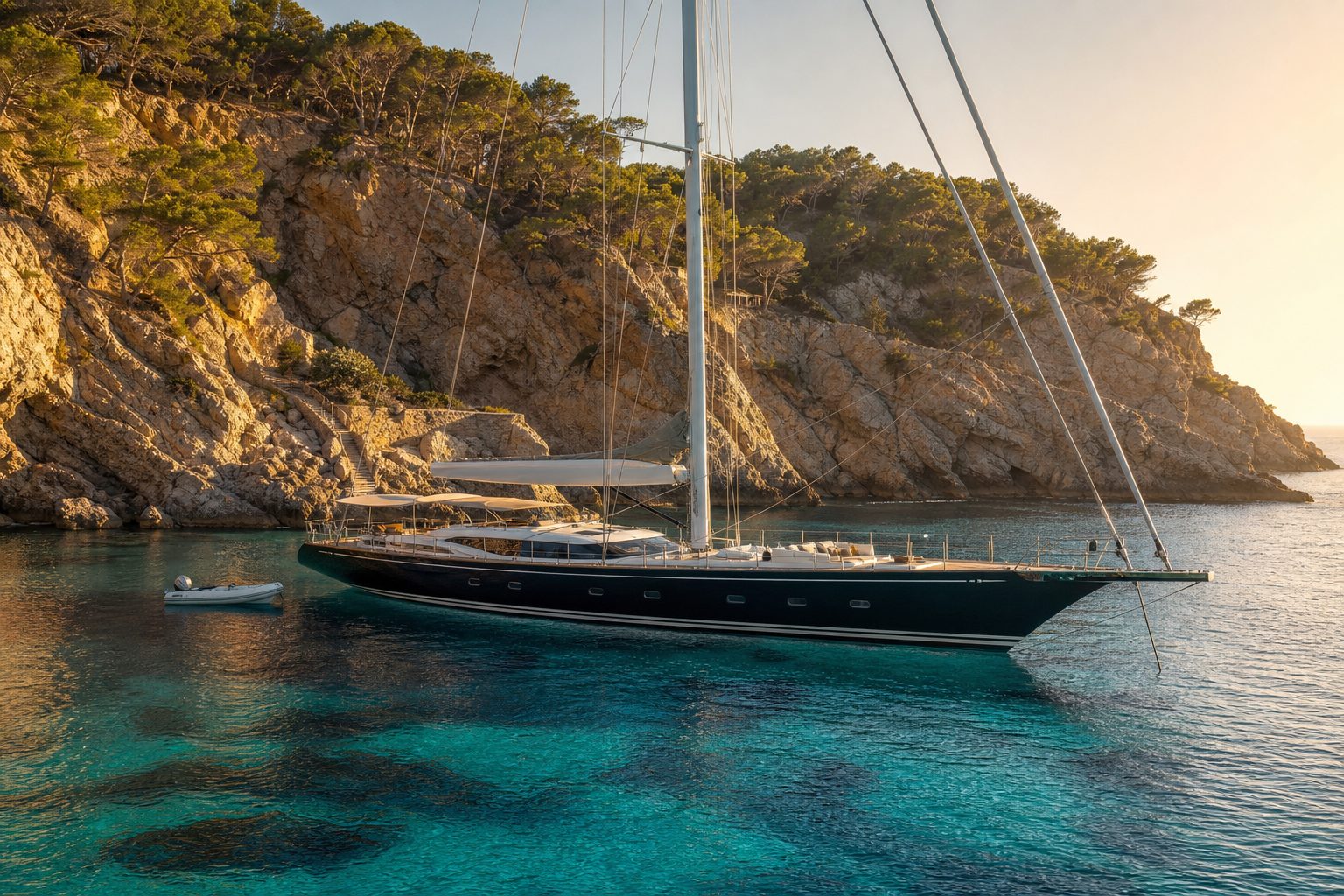
What seduces people, in the end, is the cadence. A day on a well-run charter has a shape that land holidays rarely achieve: a slow waking in a quiet anchorage, a swim into water so clear the boat seems to float on air, a long breakfast on deck as the captain proposes the day's possibilities. A morning sail to somewhere new; lunch at anchor and the deep, sun-drugged idleness of the afternoon — swimming, the paddleboard, a book, a nap in the shade of the sail. Then the golden hour, an aperitif on deck as the light turns the cliffs to honey, a tender ride ashore for dinner or a meal cooked aboard, and the particular peace of sleeping on gently moving water under a sky with no light pollution at all. It is, when it works, the most complete switch-off in travel.
Chartering the Mediterranean well
- Choose your sea. The western Mediterranean, the Adriatic, the Aegean and the Turkish coast each offer a distinct character — glamour, island-hopping, ancient ruins, quiet coves. Match the cruising ground to what you want from the week.
- Crewed, almost certainly. Unless you are a qualified and confident sailor, charter with a crew. The captain's local knowledge and the chef's cooking are most of the experience.
- Mind the season. High summer brings reliable sun, crowded anchorages and peak prices; the shoulder months of late spring and early autumn are often lovelier, quieter and better value, with warm seas.
- Understand the running costs. Beyond the charter fee, budget for fuel, food, harbour fees and the customary crew gratuity — often quoted separately and easy to underestimate.
- Be honest about sea legs. If anyone in the party is prone to seasickness, favour a larger, more stable vessel, calmer cruising grounds and the shoulder season.
The reckoningThe sea deserves the same honesty
A yacht is not a low-impact way to travel, and the sailing romantics among us must be honest about it: even under canvas, a charter involves fuel for the engine and the tender, provisioning, and the broader pressures that tourism places on fragile coasts and seas. The most responsible charters minimise this where they can — sailing rather than motoring whenever the wind allows, managing waste rigorously rather than discharging it, anchoring on sand and designated moorings rather than dropping iron onto the seagrass meadows and reefs that the Mediterranean's marine life depends upon.
That last point is more important than it sounds. The Posidonia seagrass beds of the Mediterranean are vital, slow-growing carbon stores and nurseries that careless anchoring destroys in seconds and which take decades to recover. A good captain knows where they are and will not anchor on them; choosing crews and charter companies who take this seriously is a small decision with a real consequence, and exactly the kind of considered choice that, to us, separates luxury from mere expense. The sea gives the charter everything; the least the charter can do is tread lightly on it.
The sea gives the charter everything. The least a good crew can do is tread lightly on it.
The verdictRuined for the dock
There is a moment, usually around the third day, when the rhythm of the sea has fully replaced the rhythm of land, and the holiday becomes something other than a holiday. The phone has lost its grip; you have stopped checking the time; your world has shrunk to the boat, the water, the light and the small company aboard, and it turns out to be more than enough. People come off a good charter changed in a small, durable way — slower, calmer, a little reluctant to return to a life measured in appointments.
That is the quiet secret of the Mediterranean by sea: that beneath the cliché of the superyacht lies one of the most genuinely restorative ways to travel that exists, available not only to the owners of boats but to anyone willing to charter one for a week. Choose sail or motor by your nature, take a good crew, tread lightly on the water that carries you, and the sea will give you back a version of the Mediterranean — uncrowded, unhurried, impossibly beautiful — that the land simply cannot. It does, fairly, ruin you for the dock. We can think of no better recommendation.