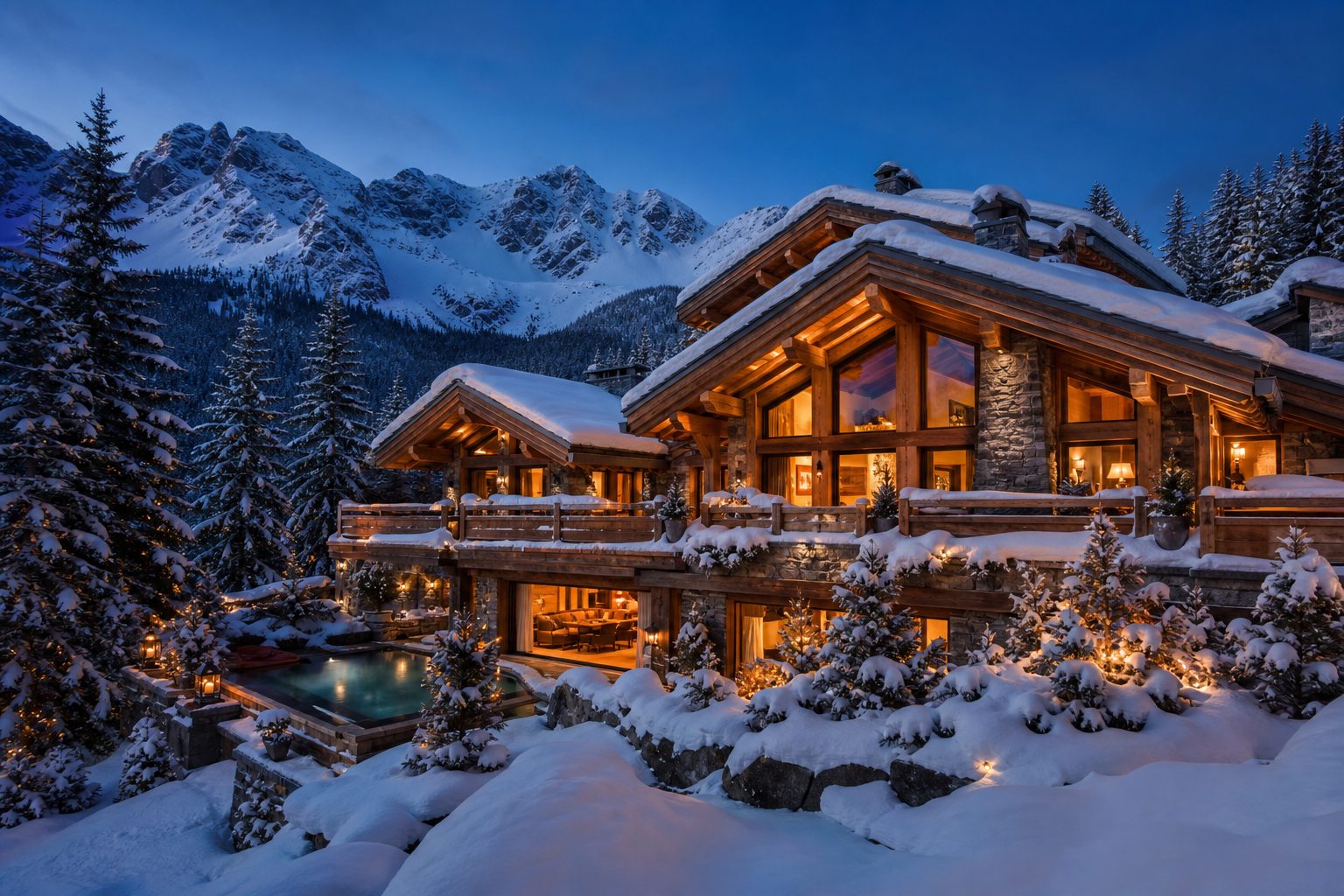
The image is fixed in the collective imagination: snow falling past a lit window, a fire in a stone hearth, the day's cold still on your cheeks as you come in from the mountain to find dinner waiting and the lights of the village strung out below. The Alpine chalet has sold that fantasy for a century. What has changed — and changed dramatically in the past decade — is the standard of what waits behind that lit window, and the quiet, ceremonial way the new luxury of the mountains is meant to be enjoyed.
The catered chalet was, for a long time, a slightly amateur affair: a rented mountain house, a cheerful seasonal cook, fondue on Tuesday, charm standing in for polish. That version still exists and still has its devotees. But above it has grown an entirely new tier — the private chalet as a fully-staffed, hotel-grade residence, with a spa in the basement, a chef who would not be out of place in a city restaurant, a dedicated host and driver, and a level of finish that rivals any grand hotel, all of it yours alone for the length of your stay. It is one of the most complete luxury experiences in travel, and the snow is almost the least of it.
The shiftFrom rented house to private residence
The defining feature of the modern luxury chalet is privacy at scale. Where a hotel offers a room in a building full of strangers, the great chalet offers an entire house — five or six bedrooms, vast living spaces, a wellness floor, sometimes a pool — taken over completely by one family or group, with a full staff who run it invisibly around you. The model is closer to a private villa than to a hotel, and it suits the way people increasingly want to travel: together, in comfort, without the compromises of shared space.
What the new chalets have borrowed from the hotel world is the back-of-house discipline. The best are run by a resident chalet manager and a team — chef, housekeeping, a driver who shuttles you to the lifts and collects you from dinner — operating to a standard the old seasonal-cook model never approached. Breakfast is whatever you want, whenever you rise; afternoon tea appears as you come off the mountain; dinner is a serious, multi-course affair cooked to your preferences and served at your table, in your house, on your schedule. The luxury is not merely the finish of the building, lovely as it is. It is the dissolution of every logistical friction that usually attends a group holiday.
The modern chalet is not a room in someone else's building. It is an entire mountain house, run invisibly around you.
The experienceWellness, the chef, and the unhurried day
Two developments more than any other define the new mountain luxury. The first is wellness. The serious chalet now treats its spa floor as a centrepiece rather than an afterthought — a pool, a sauna and steam room, a hammam, treatment rooms with a therapist on call, sometimes a gym and a hot tub set in the snow under the stars. After a day in the cold and altitude, this is not indulgence so much as the thing that makes a week of hard skiing sustainable, and for many guests the wellness floor has quietly become as important as the slopes.
The second is the food. A private chef changes the entire rhythm of a mountain holiday. There is no booking restaurants, no trudging out into the cold for dinner, no compromise between what the children will eat and what the adults want; there is simply a kitchen that bends to your household, cooking to your tastes and dietary needs, sourcing the region's mountain cheeses and charcuterie and game. The day acquires a lovely, unhurried ceremony: a long breakfast, the mountain, a late lunch on a sunny terrace, the spa, an aperitif as the light goes pink on the peaks, and an unhurried dinner at home. You are skiing, but you are also, in the deepest sense, resting.
Beyond the skiing
It is worth saying plainly that the modern Alpine winter is no longer only for skiers. A growing share of guests at the finest chalets ski little or not at all, coming instead for the scenery, the wellness, the food and the particular magic of a snowbound mountain village — the walks, the horse-drawn sleigh, the long lunch, the fire. The Alps in winter have become a destination in the way a beach is: a place to be, not merely a place to perform a sport. The best chalets are designed accordingly, as houses you would happily never leave, with the skiing as an option rather than an obligation.
Choosing a chalet well
- Location is everything. "Ski-in, ski-out" is precious with a group and a lot of equipment; a chalet a cold drive from the lifts can undo much of the luxury. Verify the real distance to the slopes and the village.
- Confirm the staffing. "Catered" covers everything from a part-time cook to a full resident team. Ask exactly who is there, when, and on which days they're off.
- Inspect the wellness. A genuine spa floor — pool, sauna, treatment room — transforms the week. A token hot tub on a balcony does not. Know which you're getting.
- Match the resort to the group. Some resorts are built for serious skiers, others for scenery, dining and being seen. The right village matters as much as the right house.
- Book the season, not the week. The finest chalets for peak weeks (the holidays, the festival season) are reserved a year or more ahead. Plan early or travel in the quieter, often lovelier, shoulder weeks.
The reckoningThe mountain under pressure
The Alps in winter carry their own uncomfortable truth, and it is the snow itself. Warming winters have made low-altitude snow less reliable and pushed the dependable season higher up the mountain, with real consequences for where it makes sense to go and for the artificial snow-making on which many resorts increasingly lean. The responsible traveller chooses higher, snow-sure resorts, travels in the heart of the season rather than its fragile margins, and supports the operators and communities investing in a future for the mountains beyond a single sport — summer programmes, year-round wellness, a less monocultural relationship with the snow.
There is the question of getting there, too. Much of the romance of the Alps is, happily, reachable by rail — the great train journeys up into the mountains are part of the pleasure, and far gentler on the planet than the short-haul flight-and-transfer. For European travellers especially, arriving by train, watching the landscape rise and whiten through the window, is not a sacrifice but an upgrade to the experience. It is the kind of choice this journal will always recommend: the slower, lovelier, lighter way, when it exists.
Choose the higher, snow-sure resort and, where you can, arrive by rail. The slow way up is part of the pleasure.
The verdictThe fire, the snow, the window
For all the analysis, the appeal of a season in the Alps comes down to a feeling that has not changed in a hundred years and shows no sign of fading. There is something in the combination of cold and warmth — the bite of the mountain air and the glow of the fire you return to — that satisfies at a level deeper than mere comfort. To come in from the snow to a house that is wholly yours, to be fed and warmed and looked after while the weather rages beautifully outside, is one of the oldest pleasures there is, and the modern chalet has perfected it.
Done well — the right house in the right village, the team in place, the wellness floor humming and the chef in the kitchen — a week in the winter Alps is not merely a holiday but a kind of restoration, the rare trip that sends people home rested rather than wrung out. The catered chalet has grown up, and in doing so it has rediscovered the truth at the heart of the fantasy: that the real luxury of the mountains was never the skiing. It was the lit window, the fire, and the snow falling on a house that, for a little while, is entirely your own.