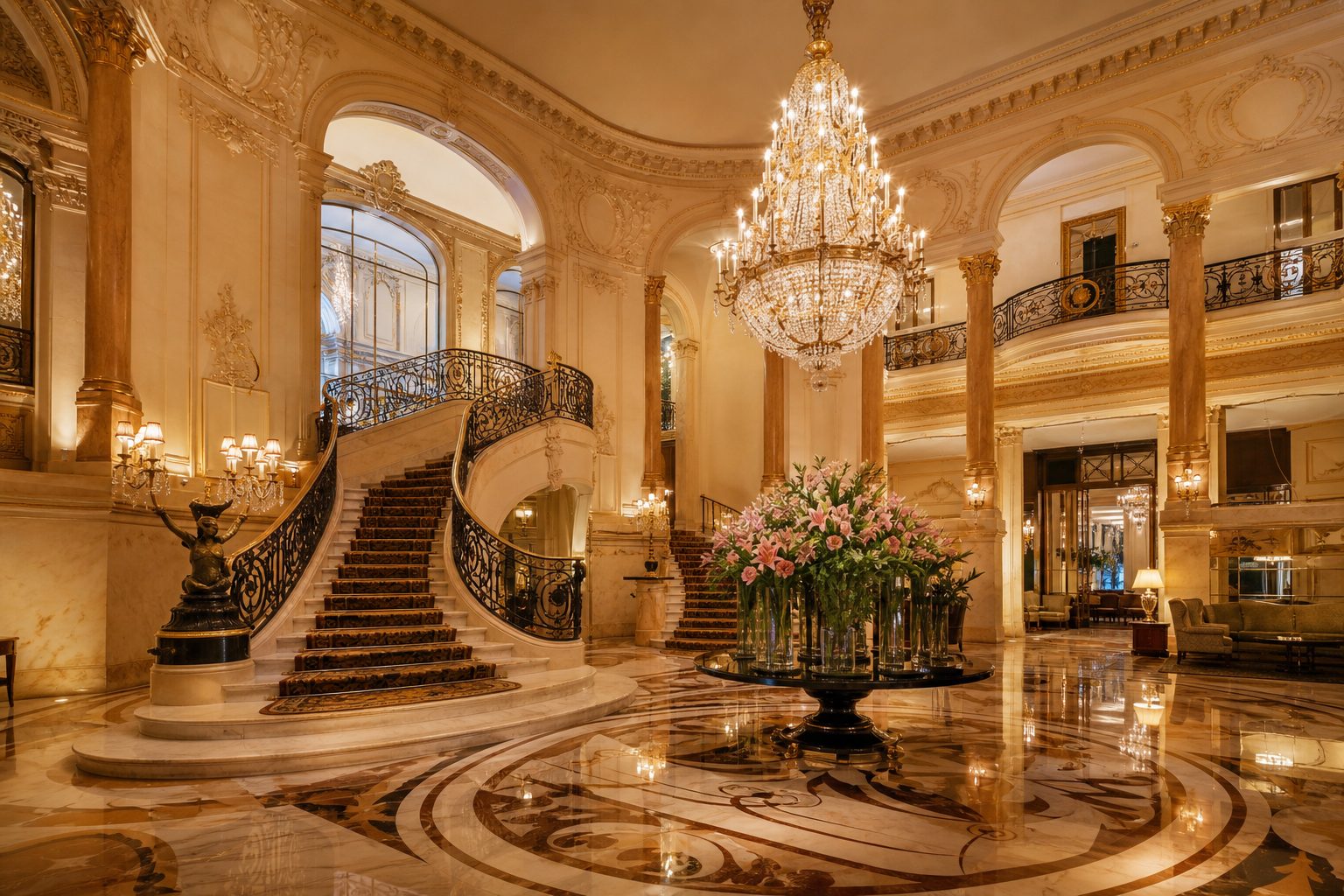
Walk into a true grand hotel and the building does something to your posture. You stand a little straighter; you lower your voice; you become, briefly, a slightly better version of yourself. It is the lobby that does it — the height of the ceiling, the hush over the marble, the sense that important things have happened here and might again. For more than a century these buildings were where cities kept their glamour, where treaties were signed and affairs conducted and fortunes lost over dinner. Then, for a while, they nearly lost the plot. Their recent revival is one of the quiet triumphs of the hospitality world.
The story of the grand hotel's decline and return is really a story about what luxury means, and how easily a great institution can forget. By the late twentieth century many of the legendary houses had drifted into a sort of genteel decay — trading on a famous name while the plumbing groaned and the restaurant coasted — or, worse, had been "modernised" into bland international anonymity, their character renovated straight out of them. The reinvention came when a new generation of owners and designers understood that the value of these places lay precisely in what made them old, and set about restoring the soul rather than replacing it.
The fallHow the great houses lost their way
Two opposite mistakes nearly killed the grand hotel. The first was neglect: resting on a legendary name, letting the fabric fade and the service calcify into a museum of itself, so that a stay became an exercise in nostalgia rather than pleasure. The second, and more insidious, was over-correction: gutting the very rooms that made a place singular and refitting them to the smooth, recessed-lighting sameness of a luxury chain anywhere on earth, on the theory that the modern guest wanted consistency above character.
Both failed for the same reason. The grand hotel's entire appeal is that it is not anywhere — it is irreducibly of its city and its history, and a night in it is a night inside a particular story. Strip that away, whether through decay or through homogenisation, and you are left with an expensive room and nothing more. The revival began when the best operators grasped that the patina, the quirks, the slightly inconvenient grandeur were not problems to be solved but the product itself.
The value of a grand hotel lies precisely in what makes it old. Restore the soul; do not renovate it away.
The returnWhat the great restorations get right
The model restorations of recent years share a philosophy that might be summed up as reverence without embalming. They pour fortunes into the things you cannot see — rewiring, replumbing, soundproofing, climate control — so that a century-old building can deliver twenty-first-century comfort invisibly. And they treat the things you can see with the care of a conservator: the original marble re-polished rather than ripped out, the murals cleaned, the grand staircase preserved as the theatrical centrepiece it was always meant to be, the bar kept exactly grand enough to feel like an occasion.
Crucially, they update the experience without updating away the romance. Rooms get larger (often by combining the cramped originals), bathrooms become the temples modern guests expect, the technology hides itself discreetly behind period detailing. The restaurant is handed to a serious chef and treated as a destination in its own right rather than an afterthought for residents. The result, when it works, is a building that feels simultaneously like a living piece of history and like the most comfortable place in the city — a trick almost nothing else in hospitality can pull off.
Service as the soul
For all the marble, the true measure of a grand hotel has always been its people, and this is where the revival is hardest-won and most valuable. Great service in such a house is not the scripted, name-repeating performance of the corporate luxury playbook; it is a quieter, deeper competence — the concierge who has run this city's doors for thirty years and can conjure the impossible without visible effort, the staff who anticipate rather than ask, the institutional memory that recognises a returning guest and remembers how they take their morning. This is the costliest thing to rebuild and the easiest to fake badly, and it is the single clearest signal of whether a grand hotel has truly returned or merely been redecorated.
Reading a grand hotel before you book
- Look past the lobby photographs. A magnificent lobby is easy; ask what the standard rooms — not the suites — are actually like, since most grand hotels have a wide range.
- Judge the restaurant and bar. A grand hotel that locals choose to eat and drink in is alive; one whose dining room is empty of anyone but guests is coasting.
- Test the concierge before arrival. A considered, personal reply to a specific request tells you more about the service culture than any star rating.
- Mind the wing. In restored houses, room quality can vary sharply between the historic and modern wings. Ask which you are being offered, and why.
- Value position over novelty. The greatest grand hotels earned their sites a century ago — on the best square, the finest stretch of corniche. That address is part of what you are buying.
The meaningWhy the grand hotel matters
There is a temptation to see all this as mere nostalgia — a wealthy traveller's fondness for chandeliers and bellhops. But something more interesting is going on, and it explains why the revival has resonated so widely. In an age when luxury has been flattened into a set of interchangeable amenities deployed identically in every global city, the grand hotel offers the one thing that cannot be rolled out from a brand standard: genuine particularity. It is a bulwark against the sameness that has crept over high-end travel, a place that could only be where it is.
A great grand hotel is also, quietly, a piece of civic infrastructure — a public room where a city's life is conducted, where you go not to hide from the place but to be at its very centre. To take afternoon tea in a legendary lobby, to drink at a bar where the city's history was partly written, is to participate in something larger than your own trip. That sense of belonging to a continuity, of being a guest in an institution rather than a customer in a building, is precisely what the corporate luxury box can never supply, and precisely what the restorations have fought to preserve.
In an age of interchangeable luxury, the grand hotel offers the one thing that cannot be franchised: genuine particularity.
The verdictWorth the occasion
The grand hotel is not the right choice for every trip; there are journeys that call for a barefoot villa or a tent on the savanna, and a marble palace would be absurd in them. But for the city stay, the celebration, the trip where the hotel is meant to be part of the story rather than merely a place to sleep, nothing else delivers what a great grand hotel delivers: the sense of having stepped, for a few nights, into a more glamorous and considered version of life, in a building that has been perfecting exactly that effect for a hundred years.
That the finest of these houses have not only survived but returned to their best — comfortable now in ways their original guests could not have imagined, yet undiminished in romance — is something to be quietly grateful for. They are among the last places where the old grand manner of travel survives intact, and where, for the price of a night, you are invited to stand a little straighter and join it.